dinsdag 24 juni 2014

Jack Kerouac

Ik heb On the road van Jack Kerouac nu bijna uit. Ik heb er een boel plezier van gehad. Om beter te begrijpen wie wie is heb ik achtergrondinformatie opgezocht. wiki/Jack_Kerouac

During World War II, Kerouac served in the Merchant Marine, which made him a veteran of the American military. He kept journals of his experiences, and he used them later to write other works. He was honorably discharged from military service in 1943 when he was diagnosed with schizoid personality disorder.[2] He was able to get veteran's benefits later, such as medical help when he was sick with phlebitis, and grant money to pay his bills while he wrote. Kerouac was proud to be an American, and always said good things about his country.

Photo: Neil Cassidy links, Jack Kerouac rechts
 
Many experiences came through Kerouac's friendship with Neal Cassady. Cassady was a handsome, bright young drifter with a teenaged wife, named Luanne Henderson. Cassady and Luanne had a hard relationship, and broke up and got back together many times. He later married another woman named Carolyn Robinson, who was older than Luanne and understood him better, but Carolyn and Cassady also had troubles. Kerouac was briefly married, to girlfriend Edie Parker. They did not stay together long, and were soon divorced. Cassady taught Kerouac, who never had a driver's license, how to drive, while Kerouac taught Cassady about writing.

Foto: Luanne Henderson                                                                  Foto, Carolyn and Neil

Neal Cassady traveled back and forth across the country, usually driving cars like Hudsons at high speed. he looked for jobs, fresh experiences, and new friends. Kerouac began to travel with him. They lived in and visited cities such as Denver, San Francisco, Monterey, and even Mexico City. They also looked sometimes for Cassady's father, who disappeared years earlier. Kerouac got sick in Mexico City, and Cassady left him behind at the hospital. Kerouac had to make his own way home. He took this very hard, and was angry with Cassady. He forgave him later, when they met again, and he made Cassady the central character of his new book. One job Kerouac could fall back on, thanks to Cassady, was as a railroad brakeman.

Many people in the 1940s and 1950s used stimulant drugs such as benzedrine, to help them stay alert. Jazz music was also popular, and some jazz musicians and listeners smoked marijuana. Kerouac was influenced by both drugs, and they changed the way he wrote. He began to write what he called "spontaneous prose", jotting down words in much the same way a musician improvises a solo in a song.

The version of On the Road that finally satisfied Kerouac was written over three weeks in 1951. It was typed on a single roll of teletype paper. Kerouac liked to type on rolls of paper, because he did not have to stop to change pages. He had just gotten married for the second time, to Joan Haverty. The manuscript was Kerouac's way to explain his friendship with Neal Cassady to his new wife. The explanation made a fine rough draft for a novel, but it did not help his marriage. Joan felt that Kerouac's nonstop work on the manuscript was an obsession, and she did not want to stay married to him after it was finished. They were soon divorced, as he was with his first wife.

The editor who worked on The Town and the City found the long, scroll-like manuscript hard to understand, and even harder to work with. Kerouac's publisher rejected the novel, as did every other publisher he went to. Nor was anyone interested in The Subterraneans, a shorter novel he wrote in three nights, about his romance with an African-American woman. Such a relationship was taboo in America during the 1950s. Kerouac continued to write, from short stories and essays to long novels, and even poetry. He tried many different subjects, but had almost nothing published. He also worked different jobs, including brakeman and night watchman.

An ongoing problem Kerouac had with fame was that people thought he did all the things he wrote about. Much of what he described (like Neal Cassady's lawless nature, promiscuity, and drug use) was only what he saw in other people. Not everyone who read Kerouac's stories understood this. Some people wanted to blame him for doing bad things, or getting others to do them. Other people wanted to do those kinds of things with Kerouac. Shy by nature, Kerouac pulled away. He became almost a recluse in the house he bought for his mother. He also began to abuse alcohol.

Kerouac was more disappointed than happy to be famous. Even though he liked some of what he inspired, he felt that the public largely got the wrong message from his books. He saw many people take what the Beats wrote as a kind of permission to get into trouble, or abandon (give up) people and things they cared about. He felt sympathy for the hippies, but disagreed with them on the Vietnam War, the role of government, and patriotism. He also lost some of his old friends, when their views differed.

Kerouac still abused alcohol and other drugs, and it harmed his health. He became bloated and irritable, and looked drunk on his last television appearance, on William F. Buckley's Firing Line in 1968. He married for the third time, to Stella Sampas, the sister of a boyhood friend. Stella looked after Kerouac and his mother, kept the public and others away, and tried to get him to stop drinking alcohol. His daughter Jan-Michelle also began to write during her teen years. He gave her his blessing, and told her "You can use my (last) name." She wrote under the name Jan Kerouac, and published novels and stories herself, from the 1970s to the 1990s. Kerouac's mother became sick, and he sometimes worked at her bedside on stories. She helped him work out the ending of Pic, his novel about a young African-American.

Kerouac wrote and reworked new material until the last day of his life. He died in St. Petersburg, Florida during emergency surgery, to try to repair a hemorrhage caused by cirrhosis, due to his alcohol abuse. He was buried in his hometown, and was hardly remembered there at first. Even though he was world famous, Kerouac earned very little money as a writer. He died with only a few hundred dollars in the bank. It was years before his grave received a headstone.

Dylan with Ginsberg at Kerouac’s grave. 1975.
fuckyeahbeatniks

Neal Cassady died more than a year before, of exposure, alongside a railroad track in Mexico. He set out to become a writer or musician, but he never got far with either. He only published one book, The First Third, which was about his youth. Cassady earned most of his money from labor, and was often out of work and owed money. He spent a long time in jail after he was arrested for selling marijuana. Sometimes the fact that Cassady was well-known through Kerouac kept him from having the life he wanted. Cassady had a family with Carolyn, but she had to both work, and raise the children when her husband was away. Carolyn later wrote a memoir.


zaterdag 21 juni 2014

Boekbinden, naar de markt en bijzondere thee

Vandaag ben ik naar het Erfgoedcentrum van Rozet geweest
 om een demonstratie boekbinden te zien van Sabine Fleischer 
 
Zij gaf een interessante uitleg en toonde allerlei gereedschappen die zij gebruikt
Zij studeerde in totaal 5 jaar en werkt nu als restaurateur van boeken
Ook maakt zij dozen om de gerestaureerde boeken
 

Ik zou zelf graag een workshop boekbinden volgen
Ik denk erover om aquarelpapier in te binden in mooie boeken
 en er dan kleine aquarellen in te schilderen 
 
 
------------------------------------------------------------------------------------------
 
Voordat ik bij haar ging kijken was ik op de markt
Ik kocht allerlei soorten fruit


In een leuk winkeltje vond ik deze thee, die goed is tegen maagpijn
 

 Ik heb nu 2 koppen op
en daarna nog geen maagpijn gehad. Wie weet......helpt het


vrijdag 20 juni 2014

Wat heb ik zoal gedaan?

Ik bakte een gemarmerde cake, die heel goed gelukt is
 

Ik zag op Facebook steeds een boek voorbij komen die ik graag wilde hebben
Ik kocht het en eergisteren kwam het met de post
Het boek is nog mooier dan ik verwachtte
Hier kun je er meer over lezen: het-engeland-van-jane-austen
 
-----------------------------------
Gisteren ben ik naar Praxis gegaan
Dit betekent een flinke wandeling heen en weer terug, leuk.....
Ik kocht bij Praxis wat ik nodig had, maar beter nog.....
Ik kon weer naar behangstaaltjes zoeken
Ik gebruik behangstaaltjes voor mijn kaarten
 
Hier zie je er een voorbeeld van
Wist je trouwens dat je de kaarten kunt kopen?
4 euro inclusief een enveloppe ( excl. verzendkosten)
Hier kun je er nog meer zien kleurrijk aquarellen
 

Ik vond een paar nieuwe staaltjes
 
En deze, ook nieuw voor me
Hoe zal een muur vol met deze kruissteken staan????
 
W A N D E L I N G


 Een bruggetje over
Onkruid ik weet het, maar zo mooi.....


Langs een raar ding....


Mooie roze waas

Een tuintje vol rozen
 
 
En een sloot vol waterlelies
 
Wisten jullie dat die er dichtbij zo uitzien?
 
En ineens......... ORANJE
Jawel, ook in deze buurt een stukje helemaal versierd
Zien jullie dat  grappige kleine huisje......
 
 Ook wij zijn in de ban van ORANJE
Mijn man is een voetballiefhebber en ik zodra er een toernooi begint


 En op de terugweg
 
Wonen wij zo landelijk?
Nee, het verbaast mij ook iedere keer
Een stukje boerenland middenin de stad


woensdag 18 juni 2014

Ik heb "de steegjes" in Denver, waar Jack Kerouac over spreekt ontdekt.


One of Denver's oldest neighborhoods, with block after block of Victorian homes mixed with luxury lofts and new housing developments, Five Points is one of the few historically  predominantly African American-owned commercial strips in the country. Some have referred to the area as the "Harlem of the West" for its jazz history, where many of the greats, including Billie Holiday, Duke Ellington, Miles Davis, and more played at clubs like Rossonian and the Rainbow Room. The area was mentioned frequently in Jack Kerouac's On the Road. The Stiles African American Heritage Center (2607 Glenarm Pl.), The Blair-Caldwell African American Research Library (2401 Welton St.) and The Black American West Museum (3091 California St.) tell the story of the African American in the West. Explore Five Points' rich heritage with the Denver Story Trek, an interactive, multimedia tour that takes you to Denver's greatest historic attractions. denver-neighborhoods/five-points/

1. Five Points is one of Denver's oldest neighborhoods, and it used to be made up of primarily German, Irish and Jewish populations. The area was named "Five Points" in 1881 for the five-way intersection of 26th Street, 27th Avenue, Washington and Welton Streets. From 1890 onward, Five Points grew into an African American community as many found work laying down track for railroad companies. It would sometimes be called "The Harlem of the West" for its rich jazz history. In 2002, Five Points was recognized as a cultural historic district.

2. The Rossonian Hotel hosted jazz legends. The Rossonian sits literally in the heart of Five Points, at the five-way intersection for which Five Points is named. Jazz greats like Ella Fitzgerald, Louis Armstrong, Billy Holiday, Duke Ellington, Nat King Cole, Charlie Parker played there. According to the Five Points Business District, many of the jazz musicians would stay in Five Points after wrapping up their downtown Denver gigs because the hotels in Denver wouldn't house them. Today however, the hotel sits empty.

3. Jack Kerouac wrote about his travels through Five Points in his literary classic, "On The Road." The Roxy and Casino Cabaret were known to count Jack Kerouac, Neal Cassady and other Beatnicks as frequent visitors. In Denver a group of fans have even spray-painted the areas visited by Kerouac with his iconic image and documented it on a Tumblr called "Jack Was Here." 

4. Five Points is home to the Black American West Museum. This fascinating museum is located in the home of Colorado's first black woman doctor, Dr. Justina Ford. The museum tells the story of black cowboys, and Dearfield, Colo. The town of Dearfield, just east of Greeley, was founded on the principles of Booker T. Washington and was an all-black town before the Great Depression ultimately forced everyone back into the cities. Dearfield is now a ghost town.

5. Five Points still honors its jazz heritage with their annual Jazz Festival. This year's Jazz Festival brought together sidewalk chalk artists, Latin music and jazz to Five Points for free music and outdoor dancing.

On the Road was a smashing success, pointing out what disillusioned youth were feeling but couldn't articulate. Are still feeling. Sex, drugs, jazz, the open road, the future, living and doing for the experience alone, searching out something to give life meaning. A quest. And Denver has a starring role in the existential story.
It took him just three weeks to bang it out. One scroll taped together, 120 feet, no margins, no paragraphs, single-spaced; just a million thoughts and stories running together like one long dispatch from the front. A breakthrough in American Letters. A new style inspired by Denverite Neal Cassady, reflecting the urgency and zest that he felt. That so many felt. The mythic scroll of the prophet. Or so the legend goes.
paint-the-town

related/to/Jack+Kerouac/


dinsdag 17 juni 2014

Jack Kerouac, on the road

In het kader van mijn boeken project ben ik begonnen met Jack Kerouac ''s On the road". Jack Kerouac behoorde tot de Beat Generation. een generatie van net voor mijn tijd. Ik groeide op met The Rolling Stones, The Beatles, Frank Zappa, Bob Dylan etc, de hippies en provo's. Ik heb nog net een staartje petticoats en hoog getoupeerde haren meegemaakt.

Ik heb wel gehoord van de beat generation maar weet er weinig van. Door het boek te lezen, zit ik er meteen midden in. Jack K. typte de oerversie onafgebroken in drie weken tijd en plakte de vellen papier onder elkaar, the scroll version.  In 1975 verscheen een gekuiste versie, het boek was bijna onherkenbaar veranderd. Pas in 2007 kon de ongekuiste versie verschijnen en deze versie lees ik nu.

Het is een en al sex, alcohol, "bop", liften langs wegen, met bussen onderweg zijn, ontmoetingen met min of meer vreemde mensen. Ik toer als een razende Roland door America. Op zich is dit allemaal al leuk, maar 100 x leuker wordt het wanneer ik Google Earth en Google erbij haal, wat een bron aan informatie is dit boek. Via het boek reis ik door steden als Omaha, Davenport. Hoe denken jullie dat Amerikanen wonen? Ik dacht eigenlijk voornamelijk aan wolkenkrabbers, maar wat zie ik nu? In heel veel steden wonen ze zo:


Brede wegen, mooie, grote huizen. Maar hele wijken op deze manier? Mij lijkt het allemaal erg saai.
Tijdens mijn zoektocht kom ik echter ook deze website tegen. Moet je hier eens kijken wat een prachtige huizen in Denver: skyscraperpage Ik heb mijn ogen uitgekeken.
 
 Op een gegeven moment komt Jack in Denver. Hij heeft het over smalle steegjes en noemt dan een straatnaam. Op Google Earth kom ik op een straat met allemaal hoge wolkenkrabbers. Hoe zit dit? Op deze site zie ik iets van de plekken waar Jack het over heeft. jack-was-here.tumblr
 
Larimer Street, the heart of skid row in On the Road, is now Lower Downtown, or LoDo, a hip area of restaurants, loft apartments and microbreweries created from century-old warehouses. The Great Divide Brewing Co is a first-rate example of new Denver, crafting excellent seasonal and year-round beers and selling them in its tap room. Original Beatnik haunts do survive in the city. Kerouac used to visit the tiny, timeless El Chapultepec, a no-frills jazz legend with red chequered floors and a stage that’s hosted Frank Sinatra and Ella Fitzgerald. Local jazz bands now take the stage nightly. Armed with a great old neon sign and beaten-up vinyl booths,
Don’s Club Tavern is another relic of the Beats’ time, an old-school dive bar that opened in 1947, and was allegedly another of Kerouac’s drinking holes. lonelyplanet


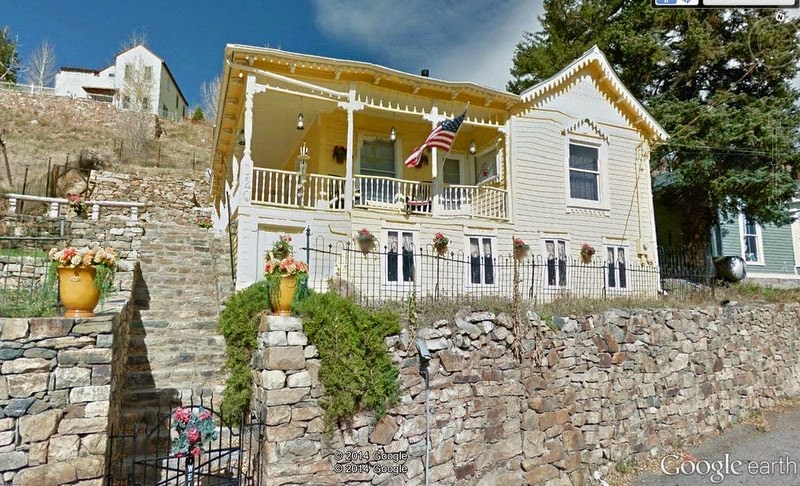
Jack maakt een uitstapje naar een Central City, een oud mijnwerkersdorp, voor het eerst komt hij hiermee in de Rocky Mountains. Ik weet niet hoe het met jullie is, maar via het veelal in mijn jeugd lezen van o.a. een strip als Lucky Luck, heeft deze naam voor mij een gouden glans. Ik zal het waarschijnlijk nooit met eigen ogen zien, maar op deze manier voelt het bijna wel alsof.......
 
Jack vertelt over de vondst van zilver. De rijkdom die dit de mijnwerkers bracht maakte dat ze een Opera huis bouwden. Dankzij internet weet ik nu hoe dit Operahuis eruit zag. 


Central City 1950
 
Almost all of the towns in Colorado in the late 1800s had one or more opera houses, many of which never hosted opera performances. A mix of local talent and touring groups occupied their stages in the heyday of live entertainment. Among the variety of events taking place in the opera houses were dances, community meetings, graduations, political gatherings, performances by local actors or musicians, vaudeville acts, minstrels, lectures, roller skating, wrestling and boxing. However, in a substantial number of Colorado's opera houses, the denizens experienced real opera, either by local groups or by traveling companies, often of considerable repute. Denverites enjoyed a fairly continual procession of opera troupes from 1881 onward. In 1870, when a railroad was extended to it, Denver became a convenient and usually profitable stop-over between Chicago or St. Louis and San Francisco for the best touring artists and companies. As railroads progressively linked other Colorado cities, entertainers could travel in circuits within the state and, eventually, make traverses across the state between Denver and Salt Lake City.

The Denver Theatre (1860) and the Montana Theatre (1861) in Central City are the earliest venues in the state where operas were staged. The earliest "opera" houses we so far have discovered are Goodnight's (1874) in Pueblo, Cushman's (1875) and McClellan's (1876), both in Georgetown, and Forrester's (1877) in Denver. The oldest surviving theatre with an opera history is the Belvidere (1875) in Central City. The oldest surviving "opera house" is Central City's 1878 building.

When the Tabor Opera House in Leadville opened in 1879, it was said to be the finest theater between St. Louis and San Francisco. Architect George King with builders J.T. Roberts and L.E. Roberts constructed the Opera House in 100 days with an estimated cost of $78,000.

Golden witnessed the opening of an opera house also in 1879, but it was not as elegant as the one in Central City or as ostentatious as the one in Leadville. Typical of many such houses, its wooden folding chairs could be removed for dances, including the seasonal grand balls.
 
Op de foto zien jullie Nellie Melba  1898 operaoldcolo.info/singers

Een stukje  "autorijden" via Google Earth leverde mij een aantal foto's van huizen in het hedendaagse Central City.
Veel huizen hebben de vlag uitgestoken

 Tuintje met schommels


zondag 15 juni 2014

Mijn boekenproject: North and South van Elizabeth Gaskell

Voor mijn boekenproject heb ik ""Noord en Zuid"" van Elizabeth Gaskell gelezen. Ik zocht in de bibliotheek naar een boek wat ik wilde lezen in het kader van mijn project en zag een dikke pil staan. Ik ben een fan van Elizabeth Gaskell. Zij was een vriendin en de biografe van Charlotte Bronte.

Op mijn  weblog over de  brontesisters plaats ik regelmatig informatie over haar. Zoals bijvoorbeeld over haar huis in Manchester wat is onlangs opgeknapt.


Elizabeth Gaskell was het tegenovergestelde van Charlotte. Een vrouw van de wereld, gelukkig getrouwd, een paar dochters, veel gereisd, opgewekt en geliefd. Toen Charlotte haar Jane Eyre publiceerde wilde de hele mondaine wereld van het Londen van de 19 e eeuw, haar ontmoeten. Iets wat Charlotte aan de ene kant heerlijk vond, maar tegelijkertijd ook heel erg ENG. Want zij was dodelijk verlegen. Zo kwam ook de ontmoeting tussen Elizabeth Gaskell en Charlotte Bronte tot stand. Het klikte en zij werden vriendinnen. Elisabeth bezocht Charlotte en haar vader 1 maal in Haworth en Charlotte bezocht Elizabeth regelmatig.

She met Charlotte Brontë in August 1850 at the Lake District summer home of social reformer James Kay-Shuttleworth, and they instantly became friends. Charlotte wrote of Elizabeth that she was "a woman of whose conversation and company I should not soon tire. She seems to me kind, clever, animated and unaffected". elizabeth-gaskell

Elizabeth Gaskell schreef meerdere boeken en 1 ervan heb ik nu gelezen. Ik heb van het boek genoten. Het is geschreven in een vlotte, leesbare stijl. Het is dat  mensen zich verplaatsen in een omnibus en koetsjes, anders had ik kunnen denken een modern boek te lezen. De thematiek is wel van die tijd. Margaret Hale woont met haar ouders in een prachtige, landelijke omgeving. Het leven is rustig en goed. Haar vader, die predikant is, krijgt gewetenswroeging. Ik begrijp niet helemaal waarover hij wroeging krijgt, misschien dat mensen uit die tijd dit beter konden begrijpen. Hij geeft zijn predikanten plaats op en verhuist met vrouw en dochter naar het industriële Noorden. In de 19-e eeuw komen de eerste textiel machines die het vroegere handwerk overnamen, met arbeiders zonder rechten. De stoom van de fabrieken vervuilen de stad, de stad is lawaaiig, er heerst onder de arbeiders veel woede, het verkeer is druk, het is er vies en het stinkt.

Margaret vindt het er vreselijk. Al snel ontmoet haar vader een rijke koopman, John Thornton, en sluit hier vriendschap mee. Margaret en haar moeder vinden het allemaal maar niets. Maar allengs raakt Margaret ingeburgerd en sluit zij vriendschap met en arbeidersgezin. Met Robert maakt zij ruzie.  Dan slaat het noodlot toe en de beide ouders van Margaret overlijden. Zij keert terug naar haar familie. Tot haar verbazing blijft zij hunkeren naar het industriële Noorden en naar Robert. Een aantal gebeurtenissen maken dat zij elkaar toch weer ontmoeten, zaken uitpraten en uiteindelijk komt alles goed.
------------------------------------------
In Mary Barton and North and South, Gaskell uses the form of the typical Victorian romance novel to bring to the fore certain important social issues, such as industry, the role of women, and the differences between our internal and external behaviours in different settings. It is in how she strays from the traditional superficiality of the style, that much of the interest in her novels lies. She sets these novels in a socially acceptable way to the audience of her day, but deliberately turns the work round so that it is by no means a simple romance. Her ability and willingness to do this is a credit to her writing skills, and should not be used to denigrate her work.
 
Gaskell's ability to combine an apparently superficially attractive writing style with serious attitudes, something which can be argued works more in her favour than against her, is particularly apparent in North and South (1854
 
She balanced motherhood with writing, travelling, socialising.
There was her charity work, too - visiting the poor and taking up cases of abused children. Elizabeth would also involve herself in other peoples' lives, such as advising Charlotte Bronte on whether or not to marry a man she didn't love.
Elizabeth became part of several social circles. There were her Unitarian friends - informed, clever and concerned. There was a sisterhood of free-thinking women, including Florence Nightingale and Charlotte Bronte.
But it was the literary circles into which she was invited that gave her greatest joy and in which she would find herself most at home. The-amazing-secret-life-Cranford-creator-Elizabeth-Gaskell

List of Key Works by Elizabeth Gaskell
Mary Barton (1848) Takes the perspective of mill workers in the 1840's in Manchester, England. Addresses the issues of working class life and struggle while maintaining a sentimental attitude throughout.
Cranford (1853) Gaskell's most famous work of nonfiction. Tells of the uneventful lives of the inhabitants of a small country town in Victoria. She uses irony to examine the diverse experiences of both men and women.
North and South (1855) Almost the opposite of Mary Barton in that it take the role of the upper class sense and sensibility.
The Life of Charlotte Bronte (1857) Gaskell is most known for this biography. Though she attempts to let Bronte tell her own story through her letters, Gaskell gives the highest honor to one of her best friends. literature/elizabeth-gaskell
 

zaterdag 14 juni 2014

Panorama en een heemtuin


Ik heb weer wat panoramafoto's gemaakt
 
Het is heerlijk weer geweest. Ik heb veel in de tuin gezeten. Ik heb ondertussen nieuw aquarelpapier gekocht, dus ik kan met mijn zomer schilderij beginnen. Voor een deel heb ik het al in mijn hoofd. Ik ben al begonnen met foto's zoeken. Het wordt weer een schilderij vol rozen, zonnebloemen, vogels, vlinders, zomerse tafereeltjes.
 
Ik weet nog niet of ik deze foto's ga gebruiken
Ik verzamel ze als een soort moodboard
 
Ik heb me de hele week vol energie gevoeld, allen vandaag is het veel minder. Ik doe het daarom rustig aan. Ik wilde eigenlijk weer naar de markt, maar ik had totaal geen puf.
 
Ik heb ook nog wat foto's gemaakt van de heemtuin in onze wijk


Mooi, he, al die bloemetjes?


vrijdag 13 juni 2014

kunstenaars benodigdheden


Vandaag ben ik naar de winkel in kunstenaars benodigdheden geweest.
Ik kocht er vellen papier, 2 superkleine aquarelpenselen en 2 nieuwe kleuren verf. Ik zoek al heel lang naar verf met een goede lavendelkleur. Deze kleur heb ik nog nooit naar mijn zin kunnen mengen. En vanmorgen heb ik 2 verjaardagskaarten geschilderd. Lees verder op kleurrijkaquarellen

Boekenproject 2014

Boekenproject 2014

Boekenproject 2015

Boekenproject 2015